
22 July 2026
Recyclability under PPWR: be smart about your redesign while you prepare for compliance to a EU-harmonised methodology
Under PPWR, “recyclability (Article 6)” stops being a box you tick and becomes a grade, from A down to C, with the criteria that decide which letter a given pack gets not yet published. This article walks through what’s already locked in, what the Commission still has to define, and what that combination means for design decisions companies are making right now.
Design for Recycling and Recycled-at-Scale
For years, “recyclable” meant one thing: could the material theoretically be recycled somewhere? It says nothing about whether that process actually runs at the volume needed to handle the pack you’re holding, in the country where you’re holding it. PPWR treats those as two different questions, and building both into the legal definition of “recyclable” is one of its more consequential design choices.
- Design for Recycling (DfR): is the pack itself designed so a recycling plant can actually process it? Sleeves that block sorting sensors, adhesives that contaminate the resin stream, dark pigments that infrared sorters can’t read: these are design choices, and DfR is the regulation’s name for getting them right. This is the theoretical half of recyclability, decided at the drawing board, before the pack ever meets a waste stream.
- Recycled-at-Scale (RaS): even a well-designed pack fails this test if the EU doesn’t have collection and sorting infrastructure processing that format at real volume. RaS has nothing to do with the pack’s design and everything to do with the infrastructure around it: how many plants exist, what they were built to handle, and how much of that material actually flows through them each year. A format can be flawlessly designed and still fail here, simply because the EU never built the capacity to process it at scale.
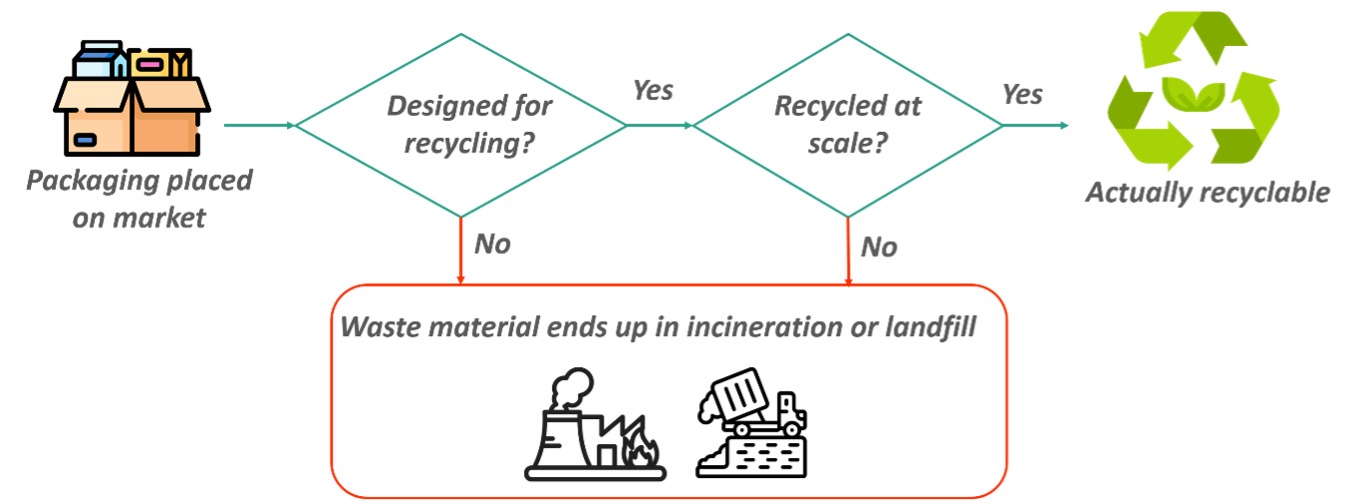
The figure below makes the practical consequence concrete: a pack has to clear both checkpoints, not one. Fail the design checkpoint, and it’s non-recyclable. Pass it but fail the scale checkpoint, and the pack was technically recyclable on paper while still ending up landfilled or incinerated in practice. Both failure routes lead to the same bin. That’s the gap between theoretical and real-life recyclability, and it’s the reason a “recyclable” label alone gives only a partial picture of what happens to a pack after disposal. It also extends the recyclability of packaging producers in ensuring that packaging is recycled at scale. This clearly recognises that they have a say in how investment is made in the recycling infrastructure, via their role in the Extended Producer Responsibility schemes.
What’s already fixed
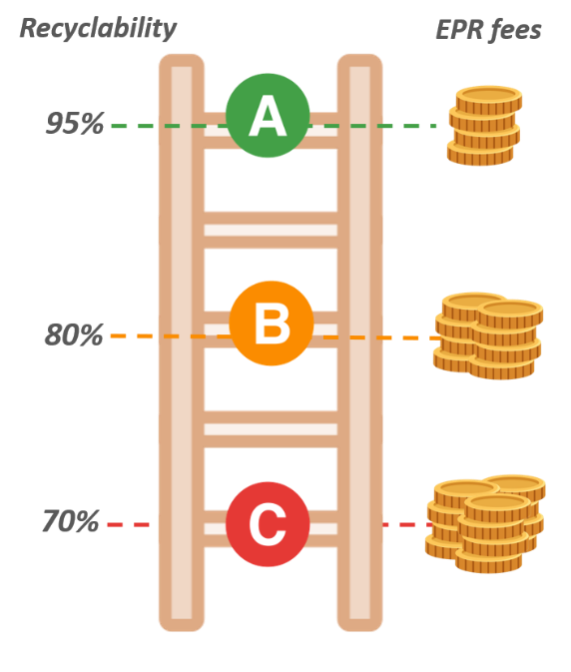
The scale itself is set. Packaging is scored on the share, by weight, of the material that is actually recyclable in practice: 95% or above earns grade A, 80% or above earns grade B, 70% or above earns grade C. Below 70%, a pack is treated as not recyclable. We already know two floors will kick in on fixed dates: from 2030, anything scoring below C can no longer be placed on the market; from 2038, C itself is excluded, leaving only A and B.
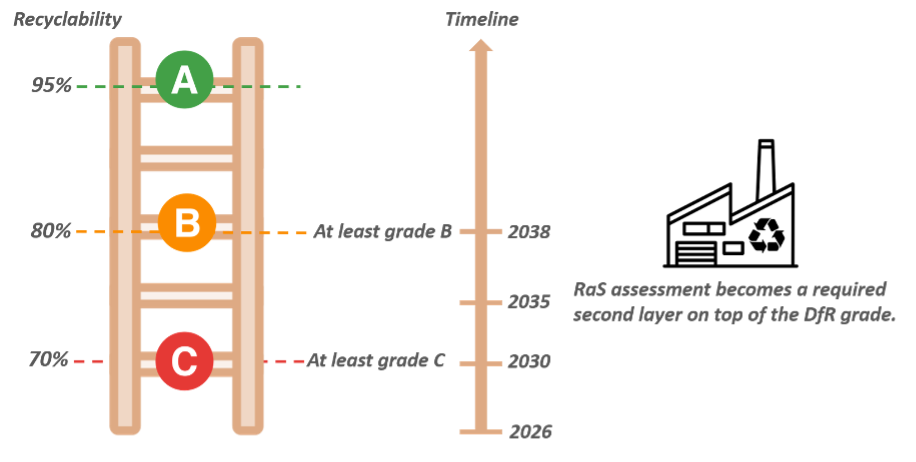
From 2035, a second layer applies on top of the grade: recycled-at-scale, checking how much of that material is actually being recycled at real volume across the EU, not just whether the pack is designed to be.
What drags a pack’s score down is a known list, and none of it will surprise anyone who’s worked on packaging design before:
- Additives that interfere with sorting or recycling
- Labels and sleeves, including PVC sleeves on PET bottles
- Closures and how cleanly they separate from the main body
- Adhesives that don’t release cleanly during washing or reprocessing
- How well the resulting secondary material actually performs once recycled
- …
There is a short list of specific exemptions, sales packaging made from textile, lightweight wood or cork being among them.
Although innovation in packaging design remains encouraged, it is now clear that innovation cannot be detrimental to recycling and to the overall environmental performance. Indeed, innovative packaging is not exempted from compliance, but only gets a 5-years delay to allow the recycling infrastructure to adapt, and at the strict condition that the innovative packaging results in “overall demonstrable environmental benefits”.
What isn’t fixed, and why it’s the part that matters
The methodology that actually assigns a pack to A, B, or C, category by category, isn’t due until the start of 2028. The Recycled-at-Scale thresholds, including how “at scale” gets defined and how collected and recycled volumes get counted per packaging type, aren’t due until 2030. The deadlines for compliance are fixed; the ruler you’ll be measured against is still being built.
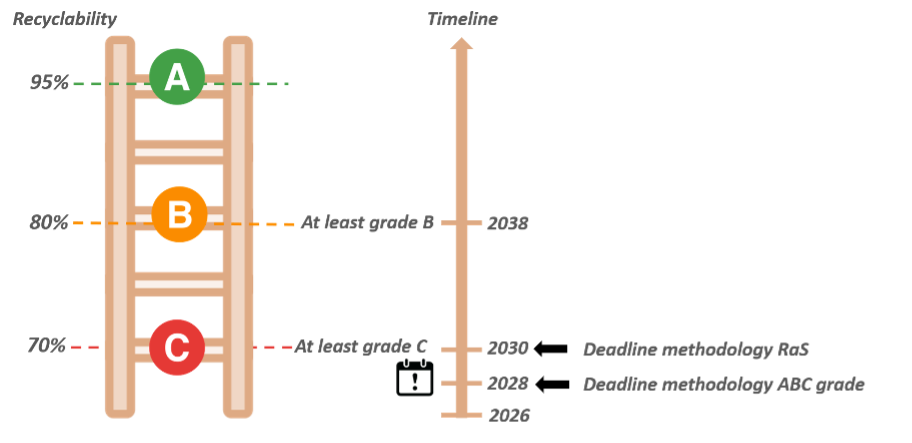
This isn’t a minor drafting delay. A multi-material laminate that looks defensible under today’s best-available standard could land in a different grade once the scoring criteria arrive. How sorting efficiency, contamination tolerance, and secondary-material quality get weighted against each other hasn’t been settled yet. Companies making packaging decisions now, on formats that will still be on shelves in 2028, are making them against a standard that doesn’t fully exist.
Until the delegated act lands, the operative reference is the older EN 13430:2004 standard, narrower and less demanding than what PPWR is clearly aiming for. Treat it as a floor, not a target. In the absence of the official methodology, the most reliable interim guidance comes from producer responsibility organisations’ own design-for-recycling guidelines, which tend to track closely with where the Commission is heading, because they’re built from the same plant-level sorting and reprocessing data. Industry initiatives point the same way. RecyClass, for instance, has run over 500 science-based recyclability evaluations and maintains Design for Recycling guidelines, giving companies a concrete framework to test against while the official methodology is still being written. None of this is a substitute for the delegated act, but together they are a far better proxy than waiting.
The money question : how recyclability can affect your bottom line
Higher grades also mean lower EPR financial contributions. In 2029, the European incentive to design packaging for recyclability will further increase as financial contributions shall be modulated according to the recyclability performance grades. It might be worth looking at redesign pathways to reach grade A for your packaging!
Several Member States have already introduced modulation based on recyclability, but today the criteria for this assessment vary from one country to another, and from one compliance scheme to another. This creates uncertainty and complexity for producers placing packaging on several markets. To solve this issue, the European Commission is working on the development of harmonised criteria for recyclability-based modulation, while not setting the amount of the fees.
Where this leaves you
Three things are worth doing before 2028 rather than after.
The first is testing design variants for medium term compliance to draw your roadmap: both the expected DfR direction and the RaS objective. You should also simulate the financial benefits the redesign can bring in terms of EPR contributions in order to inform your decision-making. Both will help you define clear deadlines to phase out the less performing packaging options from your portfolio and find alternatives that actually pass the criteria.
The second is to assess the full life-cycle impact of your packaging, rather than optimising for a grade that might shift once the methodology publishes and finding out the redesign didn’t actually improve anything on a life-cycle basis. That’s eco-design work, done in parallel with compliance rather than after it.
The third is claim discipline. As “recyclable” becomes a graded, methodology-backed term rather than a loose descriptor, the gap between what a pack is labelled and what it can actually support is going to draw more scrutiny, not less. Independent review of recyclability claims in your marketing, before a regulator or a competitor does it for you, is a smaller job now than it will be once enforcement catches up. The Directive on Empowering Consumers for the Green Transition (EU 2024/825) has clearly listed recyclability claims as part of the characteristics that traders are responsible to provide clear, relevant and information about. This is not purely theoretical. End of June 2026, Volvic (part of the Danone group) was condemned by a French court for deceptive commercial practices, notably for a “100% recyclability claim” that was judged misleading.
RDC can assist you in all these steps. Contact us if you want to know more.
This is the third article in a series of five on the EU Packaging and Packaging Waste Regulation. The next one looks at recycled content: the targets, the mass balance questiong, where recycled content claims start to diverge from bio-based content claims…


