
30 July 2026
Recycled content in plastic packaging: the targets are fixed, the accounting rules just moved
Article 7 of the PPWR sets binding minimum recycled-content shares for plastic packaging. The targets are fixed, but the method for calculating the recycled content is not; that gap is where the real compliance risk sits.
What’s already locked in
From 1 January 2030, plastic packaging placed on the EU market must contain minimum recycled content, averaged per manufacturing plant per calendar year. These targets increase by 2040.
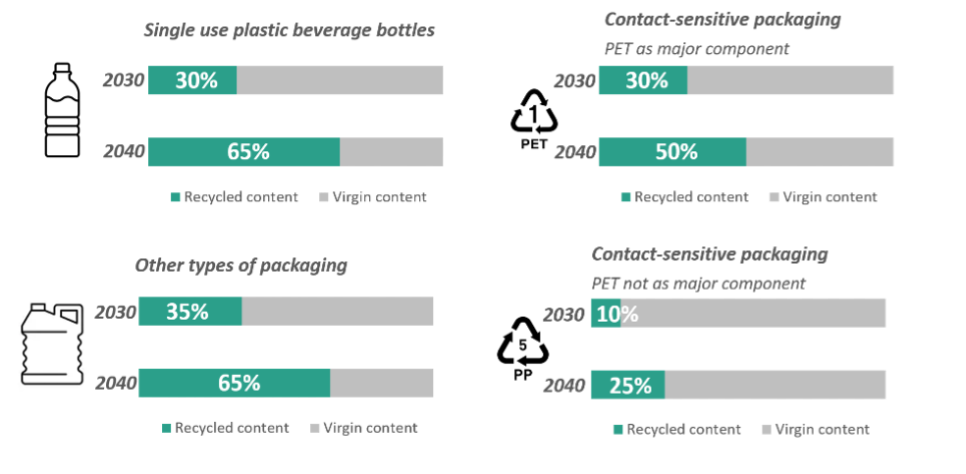
Only post-consumer plastic waste counts towards this recycled content. Pre-consumer scrap and production offcuts don’t, regardless of how a supplier’s data sheet frames them.
This means the supply chain of post-consumer plastic waste imported from outside the EU will have to comply with EU standards (or equivalent) for separate collection and rules regarding emissions from recycling facilities.
There is a short list of exemptions for this minimum recycled-content: medicinal and medical-device packaging, infant food packaging, compostable plastics, dangerous-goods transport packaging, and any plastic component under 5% of the packaging unit’s .
Recycled content also has direct impact on company cost. Under Article 7, recycled-content performance is one of the criteria that can shape fees of extended producer responsibility (EPR) schemes: High recycled content (i.e. above requirements) means lower fees, while low recycled-content can be penalised. In other words, increasing the recycled content is not only for compliance, but also to reduce cost.
National EPR schemes already reward recycled content directly. In Belgium, Valipac, the scheme for commercial and industrial packaging, pays a bonus of €100 per tonne of recycled material for plastic packaging containing at least 30% post-consumer recycled content, up from €50 per tonne when the bonus launched in 2022. Valipac frames the bonus explicitly as a way for producers to anticipate the 35% recycled-content requirement for industrial plastic packaging that applies from 2030.
What is left to decide?
None of the above is in dispute. What’s still open is how recycled content actually gets measured, verified, and documented:
- Article 7(8): implementing act on calculation and verification methodology, due 31 December 2026
- Article 7(9): delegated act on sustainability criteria for recycling technologies, due the same date, which will decide which chemical recycling routes are also eligible to generate countable recycled content
Until both are adopted, the target is certain but the arithmetic behind it is not.
The mass-balance question
Few topics in the recycled content debate generate as much discussion as this one. The PPWR text itself does not use the expression “mass balance,” but in practice that’s what Article 7(8) is really about.
Mass balance is an accounting method. If a facility processes a mix of recycled and virgin feedstock, the recycled content is considered different for the different outputs although the recycled content is physically uniform. The weighted average of the different streams is equal to the average recycled content (the “mass balance” is OK). It’s the practical way to credit chemical recycling technologies such as pyrolysis, depolymerisation, and dissolution, where recycled and virgin streams genuinely mix inside the process. This topic also arises in mechanical recycling wherever recyclate and virgin material are co-processed rather than kept separate. Several allocation methods (proportional, polymer-only, fuel-exempt) exist for distributing that same recycled feedstock across a facility’s output streams, and the method chosen changes how much recycled content ends up attributed to each one.
Until recently, no binding EU methodology existed for recycled content in packaging. On 30 June 2026 the Commission adopted the Implementing Decision on the calculation, verification and reporting of data on recycled plastic content in single-use plastic beverage bottles (C(2026) 4381), under the Single-Use Plastics Directive. It’s the first legally binding mass-balance methodology the EU has adopted for packaging, and it sets out:
- Facility-level allocation: the mass balance is calculated separately for each production facility, using the volumes of recycled and virgin feedstock actually consumed at that site over the reporting period.
- Fuel-use exclusion: where part of the processed material ends up as fuel, residues, or other losses rather than as a plastic output, that share is removed from the calculation before recycled content is attributed to the remaining output streams.
This decision applies to single-use PET beverage bottles under the SUPD only. It is not the PPWR methodology. The Article 7(8) implementing act, due by 31 December 2026 and covering a much broader set of polymers and formats under PPWR, could end up looking similar in its approach, but that isn’t confirmed, and the two acts sit under different legal bases with different scopes.
Although mentioned in this Implementing Decision, mass balance is not an automatically acceptable accounting method across every EU framework. The Commission’s 2022 policy framework on bio-based, biodegradable and compostable plastics (chapter 3.1) rejects mass balance as a verification method for bio-based content claims, accepting only direct C14 isotope measurement outside a narrow set of strict transparency conditions. The same accounting logic is treated very differently depending on which EU file it sits under.
Food-contact safety runs on its own track
Recycled-content targets don’t override food-contact safety law: recycled plastic destined for food packaging must still be produced through a recycling technology authorised under Regulation (EU) 2022/1616, whatever recycled-content percentage PPWR requires. PPWR itself acknowledges this, with Article 7(5)(a) exempting packaging from the recycled-content requirement where meeting it would breach food-contact safety rules under Regulation (EC) 1935/2004.
Setting a recycled-content strategy under unfinished rules
Waiting for the Article 7(8) act before locking in a strategy carries its own risk: supplier contracts, feedstock agreements, and capital commitments to recycling capacity are being signed now, so shortage of recycled material is likely for the unprepared industrials. Moreover, targets could be lifted up once the methodology is finalised. The SUPD decision is already published and gives a concrete example of how the Commission has approached these questions once. The PPWR act could look similar. But we’re not sure it will be.
The strategy setting should also evaluate whether compliance is the right objective. As efforts are needed anyway to achieve the targets, it is worth considering other objectives with synergies, like higher recycling content, internal recycling loops, optimised environmental management. For example mechanical and chemical recycling may count the same way toward a recycled-content percentage, but they have very different environmental profiles. Wherever it’s technically feasible, mechanical recycling should be favoured for its favorable energy and carbon balance.
On EPR, Article 7(7) allows producer fees under Article 45 to be modulated according to recycled-content share, with modulation taking account of the sustainability of the recycling technology used. The recycled-content number can therefore move the cost of putting packaging on the market, not just its compliance status.
This is where recycled-content strategy and ecodesign meet, and it’s the subject of the next article.
A few questions worth asking now:
- Supplier assumptions: are recycled-content declarations of your suppliers built on assumptions that would survive a stricter allocation rule?
- Feedstock readiness: are your suppliers ready for post-consumer-only sourcing and facility-level reporting?
- Supply chain origin: is your supply chain EU-based, or exposed to the third-country equivalence conditions that apply from 21 November 2027?
- Environmental payoff: does your recycled-content route actually improve carbon and other environmental endpoints, or just satisfy the percentage?
RDC has supported federations and PROs on recycled-content strategy assessment, mass-balance methodology review, and EPR scheme design. That kind of stress-testing is exactly what this moment calls for.
The next article in this series turns to eco-design under PPWR, and to a question this one has already raised: a packaging change that satisfies a PPWR requirement isn’t automatically a change that’s better for the environment. Sometimes it’s worse. Article 5 is about telling the difference before the redesign is locked in.


