
13 July 2026
Reuse under PPWR: binding by 2030, undefined until 2027
Reuse is the most politically loaded piece of PPWR. It’s also the part of the file where the gap between “what the regulation requires” and “what makes environmental sense” can be the widest. A 40% reusable transport packaging target by 2030 sounds unambiguous. The delegated and implementing acts that decide whether a given pallet, crate, or beverage bottle counts toward that target have not yet been adopted.
This is the environment companies desigining reuse systems currently operate in.
In this Article we discuss what this could mean in practice, and how to prepare for both compliance and sustainability.
What PPWR has already locked in
Article 11 defines what counts as reusable, through a set of cumulative criteria covering durability, safe emptying and refilling, identification, recyclability at end-of-life, and inclusion in a compliant reuse system. Miss one criterion and the unit is not reusable under PPWR, no matter how many times it actually rotates in practice.
Article 29 attaches binding targets to specific sectors, applicable from 1 January 2030,. These are shown on the timeline below.
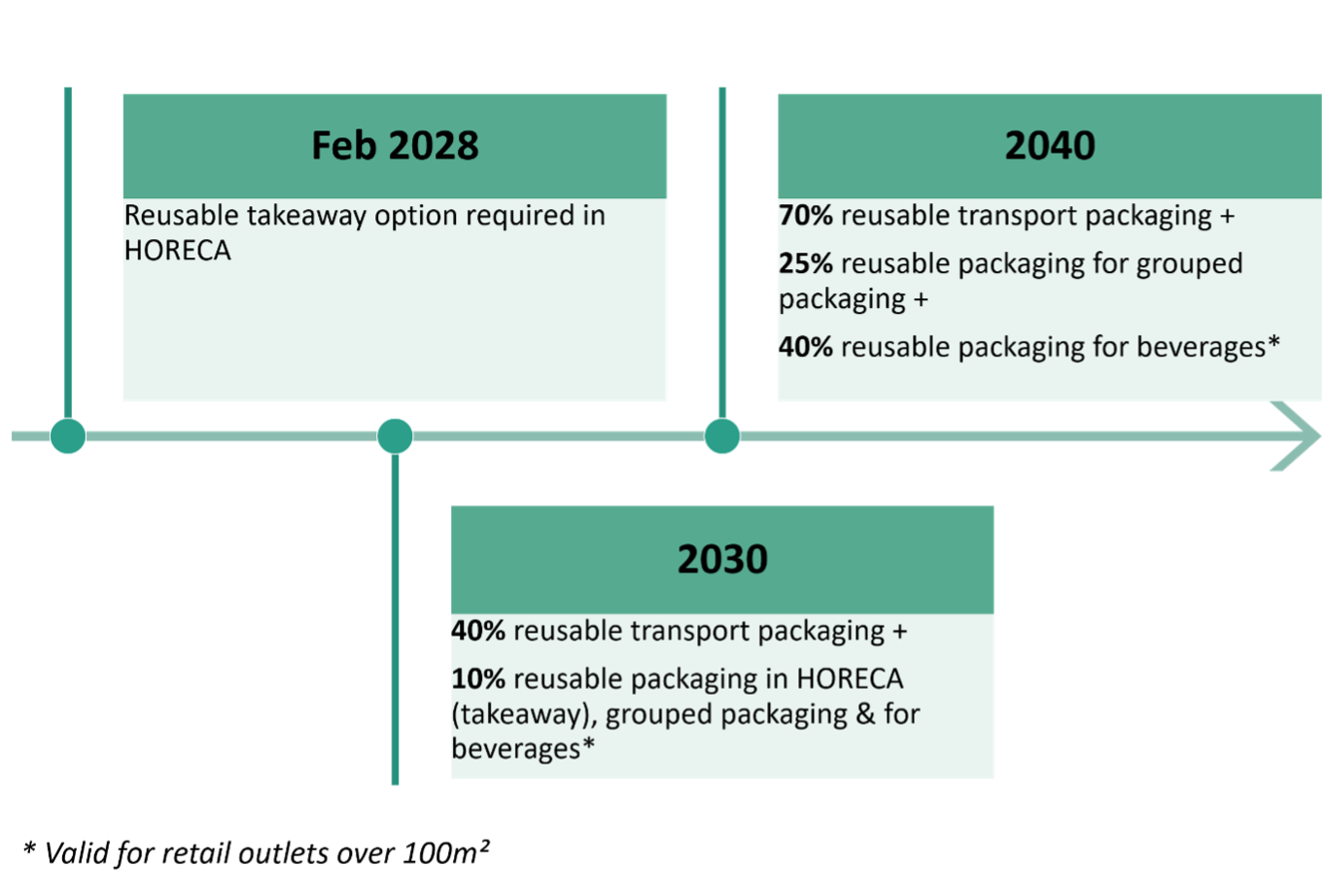
Unlike pre-existing targets for reuse, such as those introduced by the AGEC law in France, PPWR reuse targets apply to each packaging users, and are not averaged at Member State level. If you are a packaging user (industrial, retailers, HORECA) of listed packaging without introducing reusable, you need to start preparing to comply and report about these targets.
That’s the architecture. It’s the operational rules underneath it that are still being written.
What is still pending, and why it matters
Three key delegated or implementing acts have to land before the 2030 obligations can be applied in practice. None has been adopted.
Minimum number of rotations – Delegated act due 12 February 2027
The “designed for as many rotations as possible” criterion has no number attached. The delegated act is meant to fix one. Doing so is genuinely difficult, and the difficulty is not where most people assume.
The minimum number of rotations has to be at least the break-even point at which a reusable system delivers a smaller environmental footprint than the single-use alternative it replaces. The break-even point depends on muliple factors including:
- transport distance back to the washing facility
- washing energy and water consumption
- unit weight of the reusable and single-use items
- recycling rate of the single-use alternative
- energy mix of the country where the washing happens
The break-even point for a single format can vary substantially across realistic use cases.
The Commission has a choice to make. Several options are on the table, ranging from a low threshold, where a reuse system must deliver an environmental benefit only under the most favourable conditions, to a high threshold, where it must deliver an environmental benefit in virtually every realistic configuration. Between these two extremes are approaches based on average performance or percentile thresholds. Each option creates a very different reuse landscape, and the Commission has not signalled publicly which approach it favours.
Until it does, “designed for X rotations” is a placeholder. Companies investing in reusable formats need to know which side of the line their system will fall on.
Reuse-target calculation rules – Implementing act due 30 June 2027
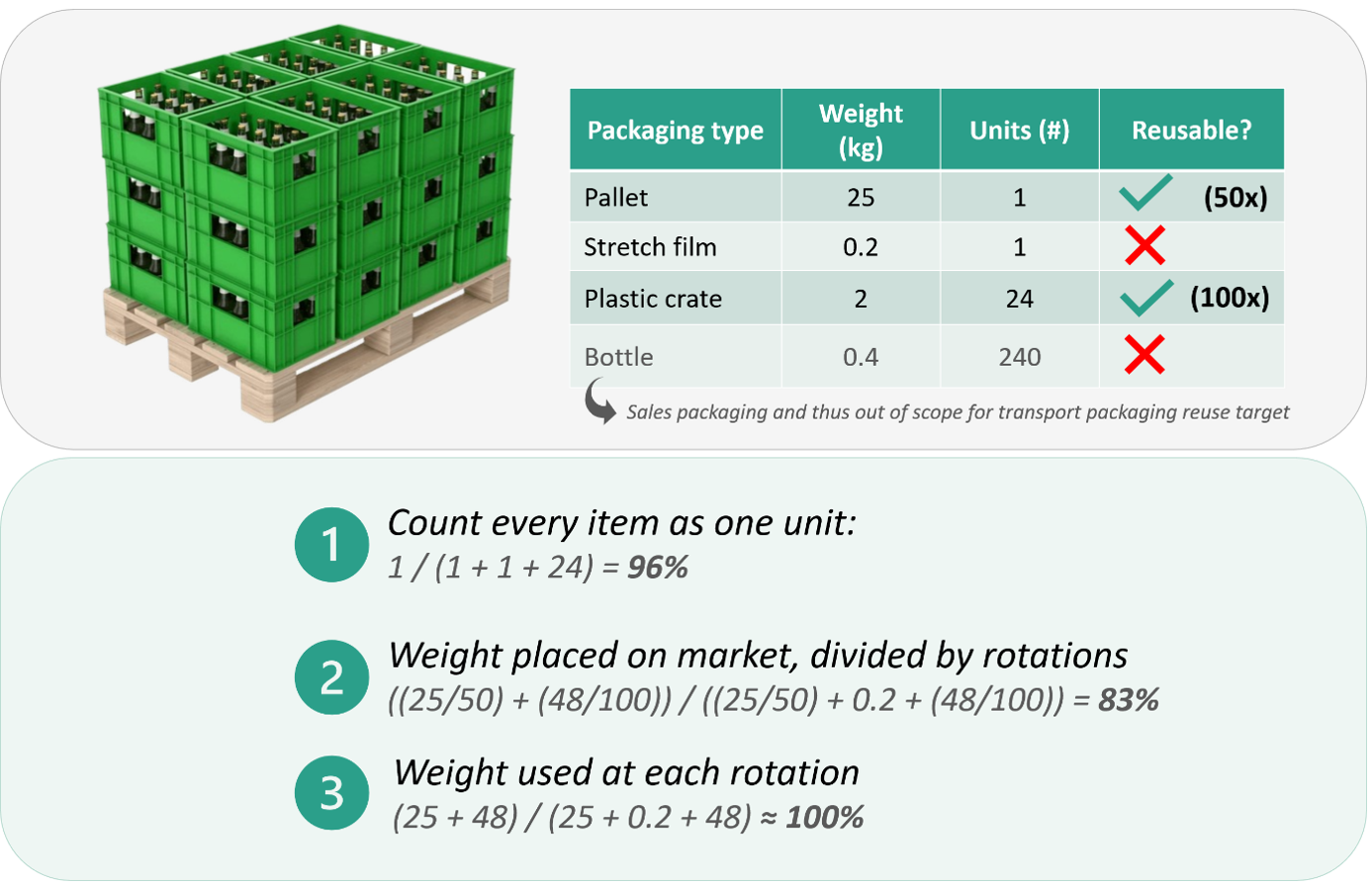
The 2030 targets are expressed as percentages of reusable packaging. These look simple in principle, but what do they mean? The PPWR does not specify exactly how these percentages are calculated; what is the numerator and denominator in this equation? The regulation introduces the concepts (“equivalent units of packaging” for transport and grouped, “units of sale” or “volume of beverages” for beverages) but does not define how to calculate them.
To illustrate why calculating a reuse rate is not straightforward, consider a single pallet load of glass beer bottles delivered to a retailer. It carries one wood pallet, one plastic stretch film, 24 plastic crates, and 240 glass bottles, for a total shipment weight of about 353 kg. Since the reuse target under Article 29(1) applies to transport packaging, the bottles are out of scope (they are sales packaging), and only the pallet, film, and crates enter the calculation. Applying three of the possible ways to count “one unit of packaging” to this same shipment. produces three different reuse rates.
Several other questions sit alongside the metric choice: which economic operator reports, how cross-border flows are attributed, how mixed packaging (a reusable pallet wrapped in single-use film, for example) is counted. None of these is answered in the regulation itself.
The application date for the reuse targets slides with this act. If the implementing act is published late, the 2030 obligations apply 18 months after the adoption of the implementing act.
Scope of the beverage reuse target
The beverage targets need a precise definition of which products are in scope. Wine, spirits, dairy, and beverages for medical or dietary use are exempt, but the boundaries between exempt and in-scope categories are not sharp at product level. Plant-based “milks”, drinkable yoghurts, kefir, fruit-based drinks containing dairy, soup-style ambient beverages: each sits in a borderland.
The Commission is expected to produce guidelines anchored in the EU Combined Nomenclature. Until those guidelines are validated, manufacturers near the boundary do not know whether the target applies to them.
The trade-off nobody wants to discuss
Reuse is good when done well. It can also be worse than the single-use system it replaces when done badly, and the gap between the two is wider than most people assume. PPWR already addresses part of this. Article 11 requires reusable packaging to be designed for as many rotations as possible, and a minimum rotation count will eventually be fixed by delegated act to even consider packaging as reusable. That is a meaningful safeguard, because rotation count is the single biggest driver of whether a reuse system pays back its higher production impact.
But rotation count is not the only driver. From RDC Environment’s extensive experience modelling these kind of reuse systems, we know what works: short loops with frequent rotations and light reusable units win clearly. Long loops with low rotation counts, heavy reusable units, and energy-intensive washing in a fossil fuel-heavy grid often lose to a well-designed lightweight single-use system.
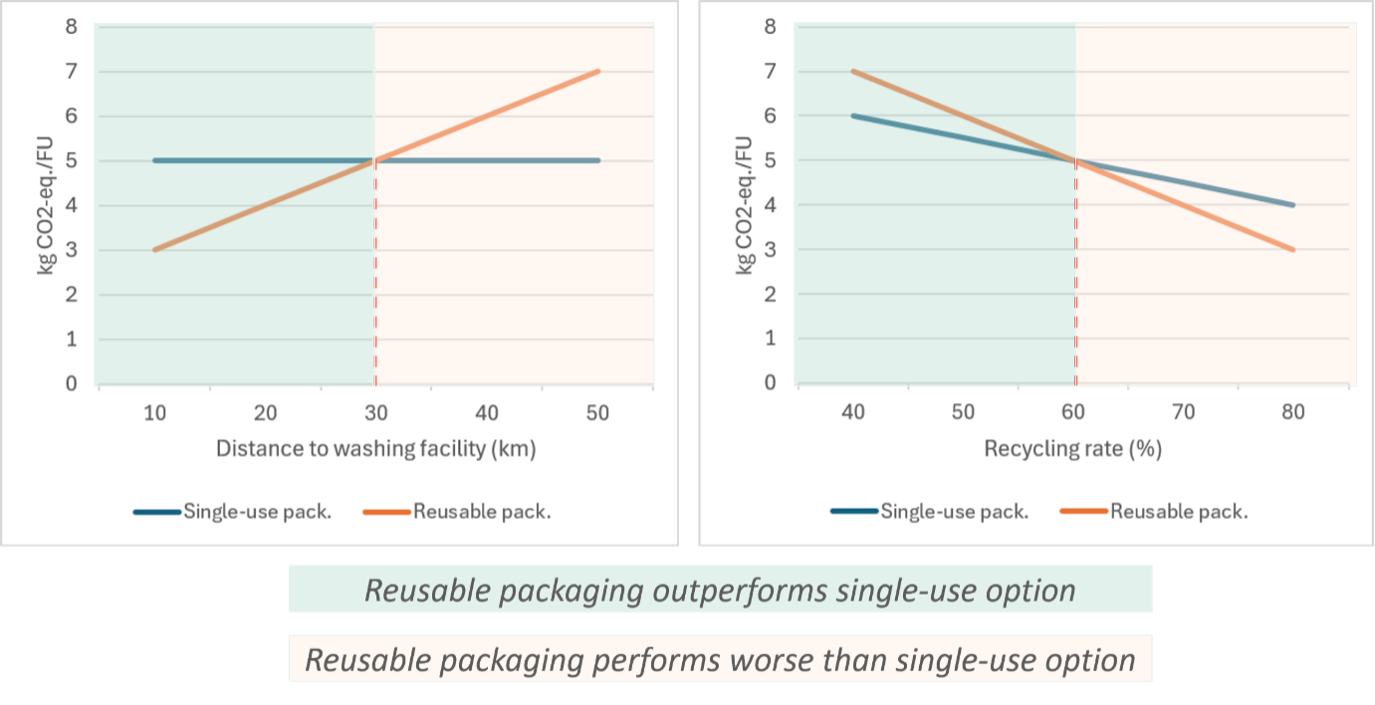
One important lesson from performing studies on different reusable packaging systems is that no absolute verdict can be made. Each reuse system has to be assessed in its own context, because the result depends on so many factors. The 2030 targets on reuse are an important policy signal. But companies should not focus blindly on simply hitting the percentage. They have to understand the context in which the reuse system is being deployed, so that the environmental impact is well understood and can be reduced where it needs to be. Otherwise the reuse system would deliver PPWR compliance on paper while pushing carbon footprint, water use, and other sustainability metrics in the wrong direction, creating a new problem to solve just as the old one closes.
Where this leaves companies, and where RDC Environment can help
Two categories of companies are dealing with reuse decisions right now.
The first is in sectors where reuse is genuinely the better answer once the system is properly designed, and where the question is execution. How many rotations are realistic? What does the return logistics network look like? Where does the break-even sit for this specific use case? What data infrastructure does compliance actually require? For these companies, the work ahead is LCA-backed system design and rotation modelling, as well as economic modelling. At RDC Environment, we support clients on cost-benefit analyses comparing single-use and reuse systems across the full life cycle, so that the investment case is built on the same evidence base for economic and environmental impacts. Get the break-even right, on both fronts, before the system design is locked. Our recent work on reuse and deposit-return systems for public authorities falls in this category:
- The Deposit Return System studies for Belgium, France, and Luxembourg compared classic and digital scenarios for glass and PET bottles, covering both reuse and recycling. Read our full article on this topic here.
- For ADEME, our comparative LCA of reusable deposit-returned glass found that reusable glass consistently outperforms single-use glass, while comparisons with single-use packaging in other materials depend on the packaging family, weight, transport distances, and number of reuse cycles. Read our full article on this topic here.
The second is in sectors facing reuse targets they have evidence to believe would deliver worse environmental, economic, or social outcomes than the single-use system they replace, typically because of specific product characteristics, contamination risks, or transport geographies. PPWR anticipates this. Article 29(18) empowers the Commission to establish exemptions for specific packaging formats where environmental issues prevent achievement of the reuse targets, alongside exemptions for hygiene, food safety, and particular economic constraints. A first Commission Delegated Decision (EU) 2026/429 was adopted this February to exempt pallet strappings and wraps from the 100% reuse requirements for transport packaging used inside one Member State or within the same company due to disproportionate adoption costs. Other delegated decisions may arise. Building the case for these decisions will require the standard scientific tools for comparing packaging systems: comparative LCA covering the full life cycle, economic cost modelling or cost-benefit analysis where relevant, to demonstrate that a single-use scenario realistically outperforms the reusable scenario.
RDC Environment has carried out this type of comparative study for several packaging types where exemption was potentially the environmentally better outcome. For EUMEPS, our comparative sustainability assessment of five fish-box systems for fresh fish in the EU found that single-use EPS delivered the lowest aggregated environmental, economic, and social impact for distribution distances above 200 km, with return logistics and insulation performance driving the outcome. The study suggests that a systematic shift to reusable fish boxes could raise both environmental impacts and costs for the sector once realistic distribution constraints are accounted for (click here for the full report). We have carried out similar assessments for CPIC (full report here) and EuPC (full report here) to evaluate whether exemptions from PPWR reuse obligations would be relevant in their respective sectors.
RDC Environment’s role in these projects is to provide a robust scientific evidence base, with complete neutrality and full methodological rigour, regardless of where the results lead.
RDC Environment supports companies and federations to examine whether reuse is the right choice, and if is to ecodesign reuse system. The combination of ISO 14040/44 LCA capability, societal cost-benefit analysis, and regulatory fluency on PPWR is what most reuse decisions actually require right now. The methodologies behind the headline numbers are still being written, and the safest hedge against that uncertainty is a system that delivers better sustainability performance on the full life cycle, not just compliant with whichever rule the Commission eventually adopts.
This is the second piece in a five-part series on the parts of PPWR that matter most in practice. The next article looks at how PPWR will grade packaging recyclability from A to C, and why the way rules that decide your grade will be decided is important.


